
Dennis Avner didn’t wear a costume. He didn’t play a role. He wasn’t a character from fiction. He was a real person who spent more than 25 years of his life transforming his body to resemble the animal he believed he truly was inside — a tiger.
Born in the small American town of Suttons Bay, Michigan, Avner became internationally known as “The Tiger Man.” Not because of his fame or fortune, but because of his radical, lifelong decision to reshape his face, his body, and his identity into something most would never dare imagine.
A Totem Becomes Flesh
Dennis Avner said he always felt a deep spiritual connection to tigers. In his view, they weren’t just majestic animals. They were powerful, solitary, and sacred. In some Native American traditions, animals serve as totems — spiritual guides that reflect a person’s true nature. Dennis believed the tiger was his.
He didn’t just admire the tiger. He identified with it. And eventually, he made the decision to no longer live as a human being who felt like a tiger — but to look like one, too.
25 Years of Body Transformation
Avner underwent dozens of procedures over the years. Each one brought him closer to his goal of embodying a feline presence:
Full facial tattoos created bold black and orange stripes across his face and body, mimicking tiger fur.
His ears were surgically pointed.
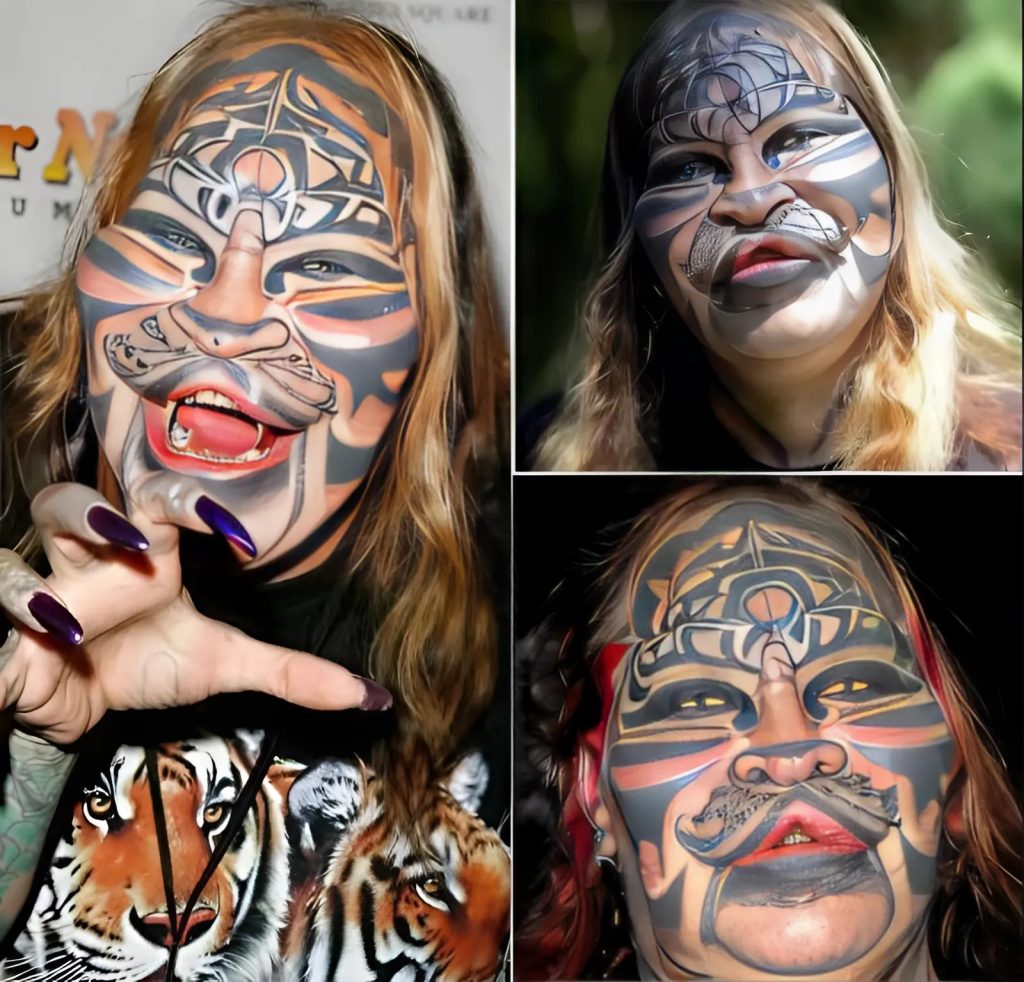
Silicone implants were inserted into his forehead, cheeks, and above his brows to give his face an angular, predatory shape.
His nose was reshaped to resemble a tiger’s snout.
His lips were surgically modified and stretched to mimic the shape of a feline mouth.
He replaced his natural teeth with custom-made fang-like dental implants.
He wore vertical-slit contact lenses, glued artificial whiskers to his cheeks, and even added mechanical claws to his fingers.
Eventually, he legally changed his name to Stalking Cat, a name that captured the essence of his identity.
Not for Fame — For Truth
Dennis never claimed he was doing this for attention. He didn’t see his transformation as a stunt or a phase. For him, this was a spiritual path. He said the changes were a reflection of his soul and that every procedure brought his physical form closer to his inner self.
He often referenced Huron and Lakota tribal beliefs, talking about the role of animal spirits and the idea of walking in harmony with one’s totem.
He believed he wasn’t just becoming a tiger on the outside. He was making his spirit visible to the world.
A Life on the Margins
Despite his conviction, the world didn’t always welcome Dennis with open arms. His appearance was often met with fear, mockery, or confusion. He struggled to find stable employment and lived most of his later years in relative isolation.
While he gained a cult following in the body modification community and appeared in documentaries and interviews, his personal life remained difficult. Friends later revealed that he battled with depression and loneliness. His physical transformation had made him more aligned with his identity — but not necessarily more accepted.
On November 5, 2012, Dennis Avner was found dead in his home in Tonopah, Nevada. He had taken his own life. He was 54 years old.
A Legacy That Still Echoes
Dennis Avner’s life raises difficult questions:
How far should one be allowed to go in reshaping their identity?
Is self-expression worth enduring rejection and isolation?
Where is the line between authenticity and self-destruction?
To some, Avner was a symbol of courage — someone who lived honestly, without compromise, even in the face of social judgment. To others, his story reflects deep pain, perhaps misunderstood or untreated, that took the shape of transformation.
But no matter the interpretation, his story demands to be remembered