
It began as an ordinary afternoon. A quiet visit to my grandfather’s old countryside home—one of those timeless places where the walls whisper memories and every drawer holds a forgotten story. The house, creaking gently in the wind, had been untouched for years. After his passing, it became a relic, locked in time.
One weekend, I decided to explore it fully. Not just walk through the rooms, but truly examine the hidden spaces—those drawers never opened, trunks never unlocked, and shelves buried behind dust-covered boxes. I wasn’t searching for anything in particular. But I found something.
In the far corner of the attic, behind piles of yellowed newspapers and faded suitcases, was an unremarkable wooden crate. It was small, heavy, and sealed shut with rusted nails. I pried it open carefully, expecting old tools or broken belongings. But inside was only one item.
At first glance, it looked like a tool. Wooden handle, metal shaft, and a curious rotating mechanism in the middle. It wasn’t labeled. There were no markings, no names, no hints. The wood was polished smooth with age, clearly used, yet preserved. I turned it over in my hands, puzzled. It didn’t resemble anything I had ever seen before.
A Forgotten Invention? A Mysterious Tool?
My mind raced through possibilities. Was it agricultural? Mechanical? A medical instrument from the past? The design was oddly elegant—precise, intentional. Whatever it was, it had once served a purpose.
I photographed it and sent the image to a few friends. No one had an answer. I posted it in online forums, where history buffs and vintage collectors exchanged theories. The guesses ranged from old weaving devices to early photography gear, even strange kitchen gadgets from the 19th century.
But none of them were right.
It was only when I stumbled across a niche archive of pre-industrial European tools that I finally uncovered the truth. A dusty catalog from 1897 listed an item that matched mine in every detail.
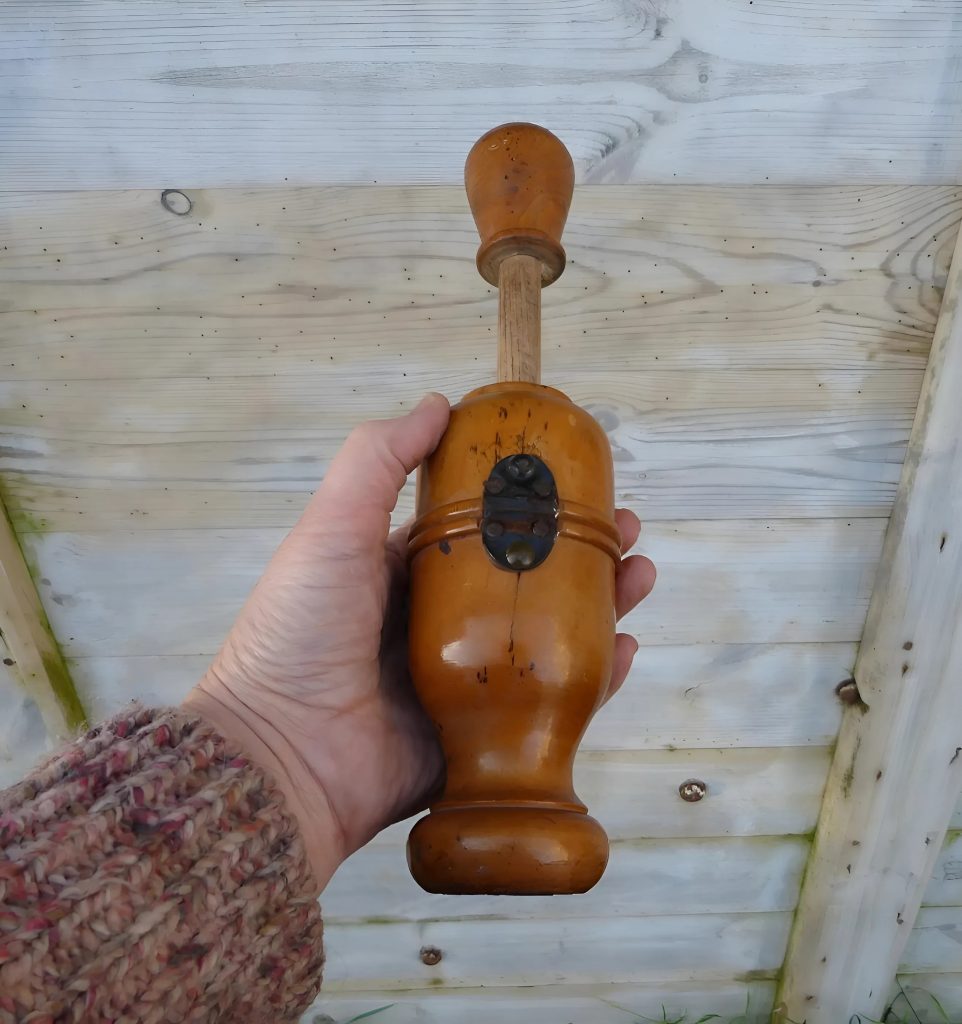
What I had found was something rare. Not valuable in terms of money—but historically. Something that told a story not just of one man’s life, but of a generation, a craft, a moment lost in time.
The Real Identity
The object was a carpenter’s marking gauge, used in the late 1800s to measure and score precise lines on wood before cutting. The handle, designed to fit the contours of the hand, allowed the craftsman to control pressure while sliding it along the grain. The rotating metal piece adjusted the spacing, locking into place with a tiny pin. It was a tool of accuracy, patience, and pride.
But this wasn’t just any marking gauge. The wood was not standard oak or ash. It was black walnut—expensive, reserved for special items. The mechanism was hand-forged, likely by a village blacksmith. And etched faintly into the underside, nearly invisible until held to the light, were three initials: E.H.S.
My grandfather’s initials.
The Hidden Legacy
Until that moment, I had never associated my grandfather with woodworking. To me, he was the quiet man who grew tomatoes, fixed clocks, and read the newspaper every morning without saying a word. But this tool revealed something deeper—another side of him. A side I never knew.
Curious, I began digging through old records. I discovered that in his twenties, before he ever worked in a factory, he apprenticed with a master woodworker. He built cabinets, chairs, and even church pews. It was a part of his life he never talked about. A passion lost to time.
And yet, he had kept the gauge. Not his paycheck. Not his uniform. Not awards or photographs. This one small tool. Protected. Hidden. Preserved.
Why?
Maybe it was a symbol. A piece of who he used to be. Maybe it reminded him of better days. Or maybe, just maybe, he hoped someone would find it one day—someone who would understand.
The Power of Forgotten Things
That day in the attic, I didn’t just discover a tool. I discovered a story. A connection across generations. An invitation to look deeper—not just at objects, but at people.
We often live surrounded by the remains of our past without recognizing them. Tools become decorations. Letters fade. Photos are boxed away. But every item, every object carries a fragment of someone’s life. And if we take the time to look, ask, dig… we might uncover something astonishing.
In a world obsessed with what’s new, maybe the most surprising discoveries are the ones hiding in plain sight—quietly waiting to be remembered.