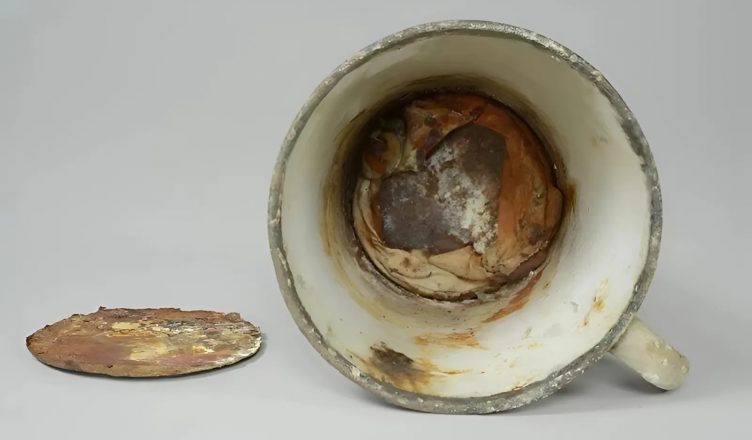
For seventy years, it sat behind glass at the Auschwitz-Birkenau State Museum—a simple, unmarked ceramic cup among thousands of items once belonging to Holocaust victims. It was ordinary, unnoticed, like many of the artifacts collected from those who were stripped of everything upon arrival at the Nazi concentration camp. But recently, this humble cup revealed a hidden truth—a secret compartment beneath its base, holding a gold ring and a pair of earrings.
The discovery is both rare and profoundly symbolic, shedding new light on how victims of the Holocaust tried, even in the face of certain death, to preserve their identities, their dignity, and a piece of their lives.
The Cup That Spoke After Decades of Silence
The discovery came during a routine conservation inspection. Museum staff noticed that the bottom of the cup was deteriorating more quickly than other parts. To prevent further damage, the cup was transferred to the museum’s restoration lab.
During the careful stabilization process, restorers noticed a strange layer at the bottom. As they cautiously removed it, a small bundle wrapped in decaying fabric emerged from a hidden cavity. Inside were a gold ring and a pair of delicate earrings—still intact, untouched, untouched by time.
This cup, like so many others, had been collected during the mass exterminations. But it had held within it a personal secret, likely placed there by a woman who—facing unimaginable terror—made the decision to hide what may have been her last physical connection to her past.
Why Hide Jewelry in a Cup?
Jewish families and other persecuted groups were often told by the Nazis to bring a small suitcase with essential belongings for “resettlement.” In truth, it was a lie. Upon arrival at Auschwitz, all their possessions were confiscated.
Some, suspecting the worst, hid valuable or sentimental items in creative ways—sewn into clothing, slipped into loaves of bread, embedded in shoes, or, as in this case, concealed inside a drinking vessel.

A cup was an item likely to be allowed to remain with a prisoner for practical use. Hiding something inside its base may have seemed safer than trying to protect valuables openly. But this act was not only about utility—it was also about hope. The hope that the war would end. The hope that survival was possible. The hope that one day, this small treasure might be recovered, or passed on.
The Emotional Weight of the Discovery
While the monetary value of the jewelry may be small, the emotional and historical weight is immeasurable. This single act of concealment speaks volumes about the humanity of its owner—someone who, even in the most dehumanizing of circumstances, tried to preserve something meaningful.
The Auschwitz Museum has confirmed the discovery and is now carefully studying the objects. Experts are analyzing the gold, the type of fabric, and the ceramic composition of the cup in hopes of tracing its origin or possibly learning more about the woman who hid the items.
Although identifying her is unlikely—records were incomplete, names erased—this discovery ensures that she is not forgotten. Her story, even without a name, becomes part of the broader history of survival, resistance, and remembrance.
Global Reaction and Reflections
The announcement sparked a wave of global attention. News outlets across continents covered the story, while social media was flooded with reactions—shock, sorrow, reverence.
One comment read: “She found a way to speak to us, decades later. Through silence, she preserved something that the world nearly lost.”
Another wrote: “This isn’t just a cup—it’s a whisper from the past. A proof that even in a place built to erase humanity, people still fought to hold on to theirs.”
Educational and Memorial Significance
The museum plans to feature the cup and its contents in a special exhibition, not only to display the objects themselves, but also to explore the practice of hiding valuables in unexpected places. It will include other recovered items that tell stories of quiet defiance and personal memory.
Educators hope to use the discovery as a powerful teaching tool—to humanize the Holocaust, to help students and visitors understand that every item represents a person, a story, a life that mattered.