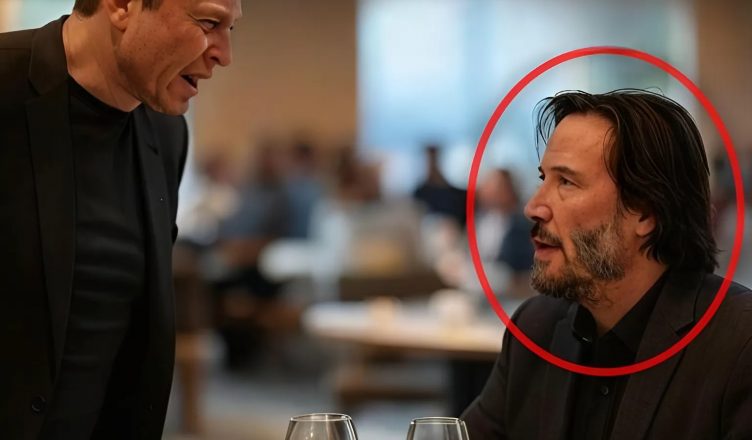
Keanu Reeves walked onto the stage with the quiet confidence that has become his signature. No flash, no theatrics — just calm presence. The audience rose in a standing ovation, but Keanu offered only a small nod and a modest smile before taking his seat.
Across from him sat Elon Musk.
Visionary. Innovator. Billionaire. A man who talks openly about colonizing Mars, merging minds with machines, and a future powered by artificial intelligence. A man who rarely filters his thoughts — and who rarely hesitates to challenge anyone.
What was meant to be a public conversation between two cultural figures quickly turned into something much deeper. A collision of two worldviews: one obsessed with the perfection of tomorrow, the other grounded in the imperfection of humanity today.
Musk took the lead early, speaking passionately about AI, neural implants, the coming age of synthetic actors, and the eventual obsolescence of human creativity. He talked about a world where stories are generated by code, where emotion is optimized, and where error is eliminated.
Keanu listened.
He didn’t argue. His answers were short, thoughtful, sometimes philosophical. He wasn’t trying to win. He was just trying to be real.
But then, visibly frustrated, Musk threw down the gauntlet.
— You just don’t get it, Keanu. The future doesn’t need actors. It doesn’t need emotions that can’t be optimized. People will want precision, not unpredictability. AI will outperform every human. Your career is over.
Gasps. Nervous laughter. An expectant silence filled the room.
Keanu didn’t flinch. He looked Elon Musk directly in the eyes and said:
— Maybe you’re right. Maybe one day people will stop watching real performances. Maybe I’ll be replaced by a flawless, digital copy. Maybe stories will be written by algorithms that know exactly what people want before they do.
He paused.
The room was still.
— But no machine has ever watched someone they love die. No AI has ever held someone’s hand through heartbreak. No code has ever forgiven what should be unforgivable. Or walked through grief. Or been humbled by joy. Or trembled with fear. Or risked everything for love.
His voice remained soft. But its weight shook the room.
— We weren’t designed to be perfect. We were meant to feel. Even when it hurts. Especially when it hurts. Because that’s what it means to be alive.
The applause erupted instantly.
People stood again. Not out of habit. But because something true had been spoken — something simple and forgotten in a world obsessed with speed, control, and simulation.
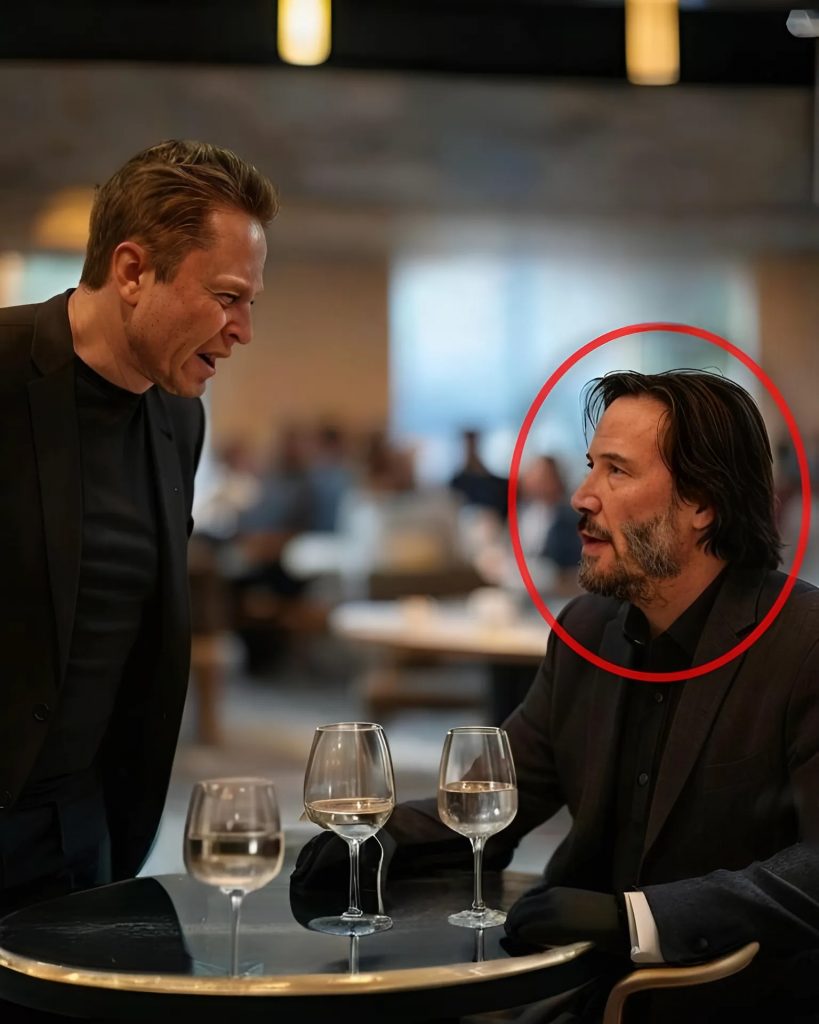
The video went viral within hours.
Not because Elon Musk had made a bold prediction. But because Keanu Reeves had reminded the world of something we’ve been too quick to abandon: our humanity.
His words were quoted by journalists, psychologists, teachers, artists. Shared across platforms, translated into dozens of languages. And yet, Keanu himself said nothing more.
No follow-up interview. No social media post. No press release.
He just left the stage.
But what he said stayed. It echoed. Not just online — but in conversations, classrooms, and quiet thoughts.
This wasn’t a battle. It wasn’t a scandal. It was a mirror.
Elon Musk spoke to a world that wants to escape limits.
Keanu Reeves spoke to a world that’s afraid of losing its soul.
One pointed to the stars. The other, to our hearts.
And it was the heart that people remembered.
Because in the rush to engineer a perfect future, it’s easy to forget the beauty of being flawed. And Keanu reminded us — without anger, without pride — that being human is not a bug in the system. It’s the entire point.
This is not a story about technology versus tradition. It’s a story about what we must never surrender — the ability to feel, to break, to love, and to choose presence over perfection.