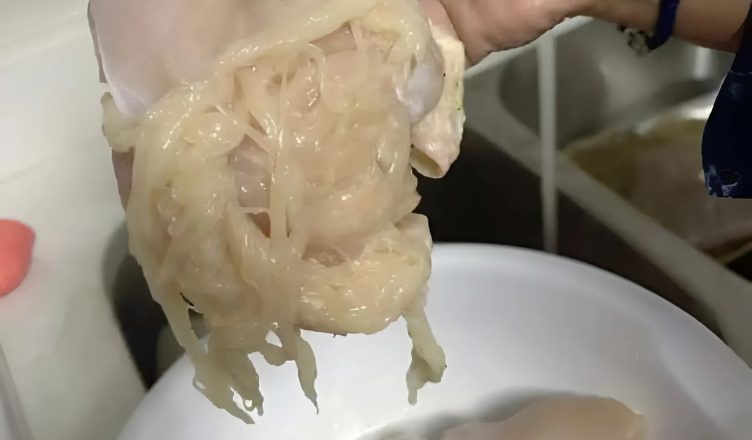
It was supposed to be a normal evening. Tired after work, I picked up some fresh chicken breasts from the store to cook a simple dinner. Nothing fancy—just a quick, healthy meal. I unwrapped the package, turned on the cold water, and rinsed the meat like I always do before cooking.
But this time, something felt… wrong.
The chicken breasts didn’t hold together the way they usually do. They began tearing apart into thin strands, almost like string cheese. The texture wasn’t just soft. It was strange. Fibrous. Fragmented. Like the meat was falling apart before even hitting the pan.
At first, I thought it might be spoiled. But there was no bad smell. No discoloration. Just chicken that looked and felt totally unnatural.
So I asked myself the same question many people around the world have been asking recently:
What is this meat, and should we really be eating it?
This isn’t a one-time thing. It’s a global issue—and it has a name
What I experienced wasn’t an isolated incident. In fact, thousands of people in recent years have reported buying chicken breasts that, once unwrapped or cooked, seem to fall apart into weird, dry, stringy fibers.
Food scientists and industry experts call it “woody breast syndrome.”
It’s a condition that affects the muscle tissue of chickens, particularly fast-growing broiler breeds raised in industrial farms. And according to some studies, up to 20% of commercially produced chicken breasts may be affected.
The result? Chicken that feels tough and dry, tears into stringy threads, and behaves more like low-quality processed meat than natural muscle.
What causes “woody” chicken?
The full answer is still being studied, but several causes have been identified—and none of them are reassuring.
Extreme growth rates
Industrial chickens are bred to grow at incredible speed. In just 5 to 6 weeks, they reach slaughter weight. This puts enormous stress on their muscles, which may not develop properly.

Poor blood circulation in the muscles
In some birds, especially those bred for oversized breasts, blood flow isn’t sufficient to nourish the tissue. The result is dead, fibrous, or “woody” muscle that lacks natural moisture.
Genetic selection and overbreeding
To meet consumer demand, producers have pushed for chickens with bigger breasts. But that selective breeding has unintended side effects—including structural damage to the muscle tissue itself.
Is it safe to eat?
At this point, there’s no clear evidence that woody chicken is dangerous to human health. But that doesn’t mean it’s good for you either.
Lab tests suggest that woody breast meat contains less protein, more connective tissue, and fewer nutrients than normal chicken. It’s harder to digest. It doesn’t cook evenly. And it definitely doesn’t taste right.
So while you can eat it, you might want to ask yourself:
Should you have to?
The real issue: consumers are left in the dark
The most disturbing part of this whole issue isn’t just the meat itself—it’s the fact that nobody’s talking about it.
Labels don’t warn you. Supermarkets don’t disclose it. And many consumers have no idea what woody breast even is. They just assume the meat is “a bit dry,” or that they overcooked it.
In reality, they’re paying for a product that’s fundamentally lower quality, due to aggressive farming practices and a lack of transparency.
Can you avoid it?
Unfortunately, there’s no foolproof way to spot woody breast meat before buying it. But here are a few things you can do:
Avoid extra-large or unusually thick chicken breasts – they’re more likely to be affected.
Buy organic or pasture-raised chicken when possible. These birds grow more slowly and naturally.
Check for odd textures when handling raw meat. If it feels overly firm or fibrous, it may be woody.
Try alternative cuts like thighs, drumsticks, or whole chickens, which are less likely to suffer from this issue.
And most importantly: trust your senses. If something feels wrong, it probably is.
The bottom line: what are we really eating?
What started as a simple dinner turned into a moment of uncomfortable realization. Our food—especially what we consider “natural”—is not always what it seems.
Woody chicken isn’t just a weird texture. It’s a symptom of an industry that prioritizes speed over quality, volume over welfare, and profit over transparency.
We all want affordable food. But should that come at the cost of nutrition, texture, and basic consumer awareness?
Next time you’re cooking chicken, take a closer look. Not all meat is created equal. And the more we understand what’s really happening in our food system, the better choices we can make—for our health, and for the future of how our food is produced.
Because sometimes, the biggest problems start with the smallest details—right there on your dinn