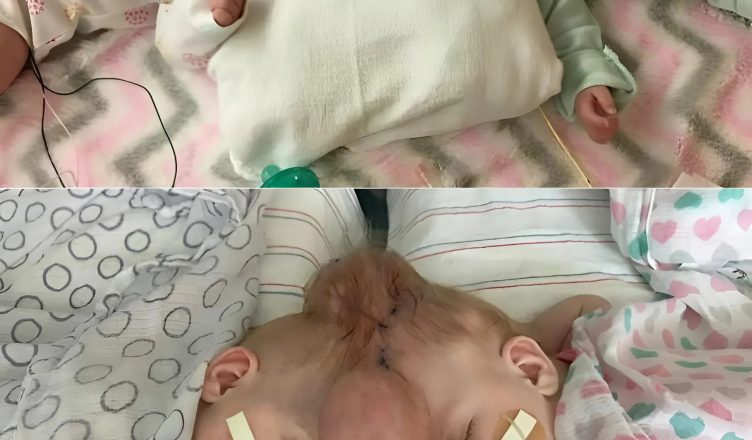
In a world filled with fleeting headlines and transient stories, there are a few that rise above the noise — stories that demand to be told, not because they are sensational, but because they redefine what it means to hope, to fight, and to overcome. The story of two twin sisters, born conjoined at the head and sharing a vital cerebral vein, is one such account. It is a narrative of impossibility turned into reality, of science pushed to its limits, and of a family whose love never wavered.
A Rare and Dangerous Beginning
When these sisters entered the world, doctors were immediately faced with a situation of unprecedented complexity. The girls were born with a rare condition known as craniopagus, where the twins are physically joined at the skull. What made their case particularly extraordinary was the shared presence of a critical brain vein — the superior sagittal sinus, a primary channel responsible for draining blood from the brain.
Such cases occur in fewer than one in two million births. The chances of survival without intervention are incredibly slim. Even with modern medicine, separation carries the grave risk of severe brain damage or death. The cerebral vein the girls shared was not just a vessel; it was their lifeline.
Doctors had to act, but they had to act with caution.
The Impossible Choice
For the parents, the birth of their twin daughters was a moment of indescribable joy — quickly overtaken by fear. They were told that their daughters might never walk, never live independently, and might not even survive past infancy. However, there was one chance — a high-risk surgery that could separate them and offer the possibility of a normal life.

It was a decision that no parent should ever have to make. Risk everything, including the life of one child to save the other, or keep them alive together in a state that could mean lifelong dependency, pain, and suffering.
After months of consultations with international experts, emotional discussions, and soul-searching, the parents made the bold choice to proceed with the surgery.
A Year of Preparation
Before the operation could even be scheduled, a full year of preparation ensued. Advanced imaging technology, 3D models, and virtual simulations were used to understand the intricate vascular system the girls shared. Specialists from various medical disciplines collaborated across continents. Neurologists, pediatric surgeons, plastic surgeons, and anesthesiologists rehearsed every step of the operation.
They mapped out the girls’ anatomy millimeter by millimeter. The objective was not only to safely separate the girls but to reconstruct their skulls and ensure each child retained sufficient brain function and blood flow post-surgery.
Every scenario, from best to worst case, was considered. But the one thing they couldn’t plan for was fate.
The Day That Changed Everything
The date of the surgery arrived, and the hospital was on high alert. Operating rooms were reserved. Equipment was sterilized. Teams of surgeons, nurses, and technicians were stationed, prepared to work in shifts.
The operation lasted 11 hours. Eleven hours of tension, precision, and extraordinary teamwork. One of the most critical phases of the surgery was the separation of the shared vein. If the blood flow could not be safely redirected, the consequences would be fatal.
And then, the moment came. The final incision. The girls were successfully separated.
When the chief surgeon emerged from the operating room, he didn’t need to say much. The look in his eyes told the story: both girls were alive. Both had made it.
The Long Road to Recovery
While the surgery was a triumph, the road ahead was far from easy. The twins faced months of recovery in intensive care, undergoing multiple smaller procedures to reconstruct their skulls and support their developing brains.
They experienced challenges — moments of instability, infections, and setbacks. But each obstacle was met with resilience. Their parents never left their sides, becoming experts in their care, and advocates for their healing.
Eventually, the girls began to sit up, to recognize faces, to smile. The first steps, the first words — each milestone was celebrated not just by their family, but by the entire medical community that had come to see them as more than patients. They were miracles in motion.
Life Today: Two Individuals, One Bond
Years have passed since that day in the operating room. Today, the twin sisters are thriving. They attend school, participate in extracurricular activities, and enjoy a life that many thought would never be possible.
One of them has developed a keen interest in science, while the other is drawn to music. They are no longer defined by their shared birth condition but by their personalities, talents, and dreams.
They remain closely bonded — not just by genetics or shared